Who will step up in midfield as the Ismaël Koné replacement for the CanMNT?


While the CanMNT won’t be forgetting about the unfortunate injury that key midfielder Ismaël Koné suffered in their win over Qatar last week, they’ll have to quickly figure out how to best replace him going forward.
For as big as that win over Qatar was, given that it was Canada’s first at a men’s World Cup, a milestone they had waited 40 years for, the work is just getting started for this team.
Heading into their third group stage game of this 2026 World Cup, which comes against Switzerland at BC Place Vancouver on Wednesday, Canada are in a position to top their group, having already all but secured qualification to the Round of 32.
Needing just a draw against Switzerland to finish first in Group B, it’ll be fascinating to see if this Canadian team can muster up that result, or better, as they look to build on what worked against Qatar.
If they’re to do that, however, they face a tall task in replacing Koné. He might not have been needed against Qatar, as Canada put in an excellent, all-around team performance, but he’s a huge loss for this Switzerland match, which is expected to be the sort of cagey game he is known for being able to break open.
"He really showed true character in that moment," 🥹
— OneSoccer (@onesoccer) June 21, 2026
Liam Millar on how Ismaël Koné handled his injury with the team 🗣️
ON LOCATION 📍 | Presented by General Mills pic.twitter.com/f2hUoxtted
He showed off those skills in Canada’s tournament opener against Bosnia & Herzegovina, where he was named Player of the Match after an excellent outing, and you just figured that he’d be up for the challenge against Switzerland.
Because of that, it’ll be intriguing to see how Canada feels they can best replace him alongside Canada’s other midfield regular, Stephen Eustáquio, as they’ve got a few options to consider.
Naturally, Nathan Saliba is the frontrunner, and rightfully so. Since making his Canada debut in the fall of 2024, he’s slowly grown into an influential piece, one who was already set up to have a breakout tournament even before this injury thrust him into a bigger role.
That he was able to come off the bench for Koné against Qatar and immediately score a beautiful free-kick, before later adding an assist, just offered a glimpse of what Saliba should be able to do.
Nathan Saliba scores a free kick and honours Ismaël Koné following the injury.#FIFAWorldCup pic.twitter.com/OebZlk2Cxm
— TSN (@TSN_Sports) June 18, 2026
But beyond Saliba, Canada has a few other players to choose from, should they want to keep their options flexible.
Mathieu Choinière’s industry on and off the ball could be valuable (as could his set-piece taking!), while Jonathan Osorio’s veteran presence could be stabilizing. And how about Niko Sigur, who has mostly played as a full-back for Canada, but has shown in past stints for club and country that he can be relied upon in midfield, a big reason why he became an essential selection for Canada at full-back?
Because of that, it feels pertinent to take a look at how each potential replacement stacks up to Koné, to give an idea both of A) who could be best suited to fill in for him and B) who could offer something else that Canada might feel they need instead.
As a result, here’s a look at how all of those options stack up to Koné. For those curious about the methodology, all of this data (coming via WyScout) is from these players’ most recent club seasons - for Choinière and Osorio, that’s the half-season of MLS action they’ve played in 2026, and for Saliba and Sigur, that’s the 2025-2026 European club season.
Then, just to add some caveats, Sigur’s stats are only from games where he featured as a central midfielder, as he split his minutes for Hajduk Split between full-back and midfield; otherwise, everyone’s minutes are from across all of the club competitions they played.
Lastly, it’s worth noting that this methodology has one big flaw to consider when looking at the data - these numbers don’t really factor in how a team plays and where a player fits in a team. For example, Koné played the 2025-2026 season in Serie A with a US Sassuolo side that played a bit more on the counter-attack, whereas Saliba and Sigur played on teams that dominated the ball a bit more (and that’s without mentioning that some played in three-player midfields, and others in double-pivots, which could also affect the data).
Plus, you have to also discount the difference in style and level between their respective leagues, especially when considering how each player stacks up to Koné, given that he was the only one playing in a top-five league.
At the same time, it should still offer a reasonable sample of data to analyze. While using this club data makes it a bit harder to see how they would fit into the system that Canada plays under head coach Jesse Marsch, enough is known about Marsch’s energetic, high-pressing system to know what metrics matter for players looking to play in midfield for him (such as progressive passes and defending stats).
With that in mind, here’s what stood out. 
Here's all the attacking data for the Canadian midfielders. All numbers on a per 90 basis except goals and assists.(WyScout)
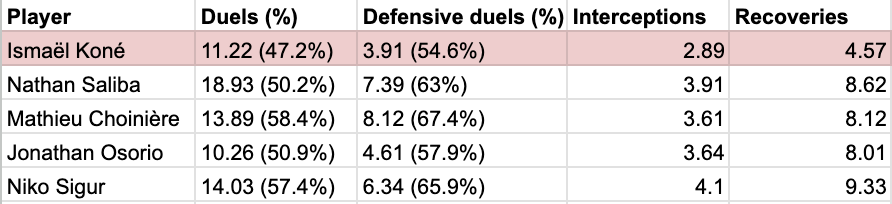
Here's all the defensive data for the Canadian midfielders. All numbers on a per 90 basis.(WyScout)
Firstly, you can see where Koné shines as a midfielder. Naturally, the big one is the way he is able to progress the ball offensively, which stands out in his dribbling numbers, progressive runs, long balls, passes into the final third, and fouls won. Even in statistics where his volume doesn’t stand out, such as those long balls or his forward passes, his efficiency is strong, as seen in the high percentage completion rate he has in both statistics.
Because of that, it’s interesting to see which players are closest to him in those metrics, specifically.
There, a few players stand out - for dribbling, Saliba is the closest, for progressive runs, Sigur and Choinière are surprise names, and for fouls won, Sigur leads the way. Otherwise, most have pretty similar numbers for long balls (Saliba’s the standout there) and passes to the final third (Choinière leads the way there), while they actually all have significantly better statistics when it comes to passes to the box and forward passes (which is likely due to the environment Koné played in at Sassuolo).
That’s interesting to see, as it suggests that, as many would expect, Saliba has some skills that are quite similar to Koné's, but that both Choinière and Sigur also stand out with some of their offensive numbers, too.
Otherwise, of course, it’s interesting to see how everyone stacks up defensively, as that could end up influencing Marsch’s decision, given how important the defensive side of the game is to his system.
There, it stands out that A) Koné’s defensive metrics aren’t that proficient, and that B) Saliba, Sigur and Choinière’s are.
Granted, that’s not surprising. While Koné is an excellent player on the ball, he’s now known for being a defensive master, although he has improved significantly on that side of his game recently. Given how good he is on the ball, though, that’s a trade-off that Marsch lived with, especially when seeing that he’s functional enough defensively to play in Marsch’s system.
To that point, though, it’s interesting to see that all of Koné’s potential replacements are stronger defensively, as that’ll allow them to slot quite seamlessly into Marsch’s system. Saliba leads the way in terms of total duel efficiency, Saliba and Choinière shine in terms of defensive duel efficiency, Sigur leads the way in interceptions (although everyone shines there), and Sigur shines in terms of recoveries (again, everyone is solid there).
So when looking at all of these numbers in their totality, what stands out?
The big one, of course, is that Saliba still stands out as the logical replacement for Koné, at least when considering his overall profile. He might not bring all of the same skills to the table, but he does a lot of similar things on the ball, and, as a bonus, he does bring something different to the table defensively. 
In particular, what he brings defensively could help Canada’s full-backs to be a bit more aggressive, for example, something that they did quite successfully against Qatar. That’s something worth noting, as it shows that even though replacing Koné means losing some of what he does so well, replacing him could also open the door for Canada to change other areas of their play based on the skills his replacement brings to the table.
To that point, though, that’s where both Sigur and Choinière stand out.
Firstly, to look at Sigur, it stands out how well-rounded his numbers are. That could be an excellent fit in this midfield, especially if he’s given the freedom to push forward - he’s already shown that he can be a dangerous attacking threat at full-back for Canada, and playing in midfield could further unlock that.
Then, with Choinière, there’s the fact that not only would he bring balance to the midfield, but there’s also the ace card of his ability to deliver quality set-pieces, something that Canada has struggled with through two games. Using him in midfield would make Canada more dangerous on those dead-ball situations, which could be a big plus.
Therefore, while Saliba is the logical choice to replace Koné, these numbers show something important - Canada can also replace Koné by committee.
What that means is that Saliba won’t need to carry the burden on his own, as Canada can also turn to the likes of Sigur, Choinière and Osorio, whether that’s to rotate in with him or to bring them in off the bench. And that’s without even going into the idea that Canada could switch from a midfield double-pivot to a midfield trio to offer even more support in that area of the pitch, as one can only wonder how two of Saliba, Sigur and Choinière could complement Eustáquio in such a set-up (no matter how unlikely that is to happen).
That’s huge to see because before, an injury like this would’ve had the potential to hamper this Canadian team severely. Just think of the way that someone like Eustáquio going down with an injury at the 2022 World Cup affected this team, as they didn’t have anyone close to his level to replace him.
Now, though, this team is much better equipped to replace key players who go down injured. That they’ve been able to deal with the injuries that Alphonso Davies, Moïse Bombito and Ali Ahmed dealt with in the lead-up to this tournament shows that, and that should continue even with Koné’s injury.
That’s a sign of Canada’s much-improved depth, for one, as well as the importance of having a clear identity, as players can step up knowing that they know exactly what they’re tasked to do when replacing someone.
Therefore, while Koné will leave a massive hole in midfield, as well as in the dressing room, Canada will feel his replacements can at least keep this team ticking and on track when it comes to their goals this tournament - and the numbers appear to back that up.