How can the CanMNT solve their finishing woes from the 2026 World Cup going forward?


As the CanMNT reflects on their journey at the 2026 World Cup, they’ll take one key lesson in stride: they need to be more clinical in big games.
The numbers speak for themselves in that regard - Canada missed a whopping 12 of the 16 big chances that they created for themselves at this World Cup, underperforming their xG of 9.7 by .7 goals. And that’s despite having a 6-0 group stage win over Qatar included in the data, which skews the numbers quite significantly - outside of that victory, Canada actually only scored three goals from 5.11 xG and missed nine of the 10 big chances in the other four games that they played at this World Cup.
In the end, that ended up having a pretty big effect on their tournament. During the group stage, their finishing potentially cost them a victory against Bosnia & Herzegovina and at least a draw against Switzerland, which would’ve allowed them to top their group, while in the knockout stage, their finishing almost cost them in their 1-0 Round of 32 win against South Africa (they missed four big chances in that game), before letting them down in their 3-0 Round of 16 loss to Morocco. 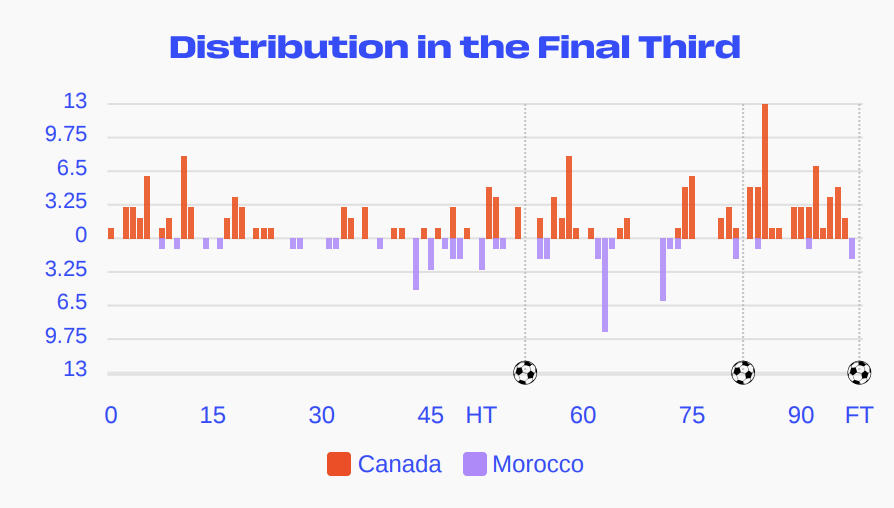
Here's the number of final third entries that Canada had against Morocco, showing that they spent most of the game on the front foot, but they were unable to make the most of that attacking thrust (FIFA)
Otherwise, the general advanced stats have portrayed this Canadian team in a pretty good light this tournament. They won the xG battle in every game that they played, as they were quite good on both sides of the ball - in particular, it stands out that they only conceded 3.3 xG in five games (an average of 0.66 per game), which are very good numbers defensively (even if they conceded six goals). Considering the injuries they had in their backline, they’ll be pleased with what they showed there, as they’ll know that they could’ve conceded fewer goals if they had a full allotment of players available defensively.
What that shows, though, is that they could’ve perhaps dreamed of a surprise run to the quarter-finals if they were more clinical in front of goal, which is not a bad thing at all - it’s encouraging for the future of this program that they can look at a run to the Round of 16 and suggest that it’s not the ceiling of what this team could accomplish.
While some will point to the fact that Canada was aided by being co-hosts of this tournament, which gave them a more favourable group stage draw, to say that would ignore the growth this team has made in recent years, as they’ve proven that they’re capable of hanging with anyone in the world on their day.
If anything, Canada’s issue has remained their finishing - showing that this isn’t a new problem. At the last World Cup in 2022, Canada underperformed their xG of 4.4 by 2.4 goals, while at the 2024 Copa América, Canada underperformed their xG of 8.4 by 4.4 goals, showing that this isn’t the first time they’ve struggled in front of goal at a major tournament.
With that in mind, it’s worth asking - what stood out from Canada’s finishing woes this World Cup?
Of course, it’s easy to suggest that the only way for Canada to improve in this category going forward is to develop a Kylian Mbappé, Harry Kane or Erling Haaland-level finisher and to call it a day, but to say that is not realistic. While it helps to have a finisher like that spearheading your attack, there are teams who had success in this tournament without a player like that, such as Spain, Morocco, Switzerland and Belgium (although they’ve all had world-class players in other positions).
Therefore, it’s still pertinent to examine the data to see if there is anything that stands out with Canada’s offence, and if they can tweak things to take better advantage of the players they have at their disposal - after all, they had minimal injuries in their attacking ranks other than the one sustained by Marcelo Flores on the eve of the tournament.
For example, before even diving into any numbers, you have to talk about Jonathan David, as the Canadian forward had a rough tournament aside from the hat trick he had against Qatar. Otherwise, he didn’t score in any of Canada’s four other games, which means that he has now been held scoreless in seven out of eight of the World Cup appearances he’s made (he also had two goals and one assist in six appearances at Copa América)
That stands out in a big way, as it’s not as if David is a poor finisher. Granted, he’s coming off a quiet debut season with Juventus, where he scored eight goals and added five assists across all competitions, with six goals from 8.81 xG in Serie A action, and two goals from 4.06 xG in UEFA Champions League action.
Just the season before, though, he had 25 goals and 12 assists for Lille OSC, including 16 goals from 16.08 xG in Ligue 1 action, and seven goals from 4.83 xG in Champions League play, which is a closer reflection of his quality as a goalscorer.
Because of that, it stands out that at this World Cup, David’s three goals came off a total of… 3.04 xG. Therefore, statistically, he performed exactly as one would expect of him. 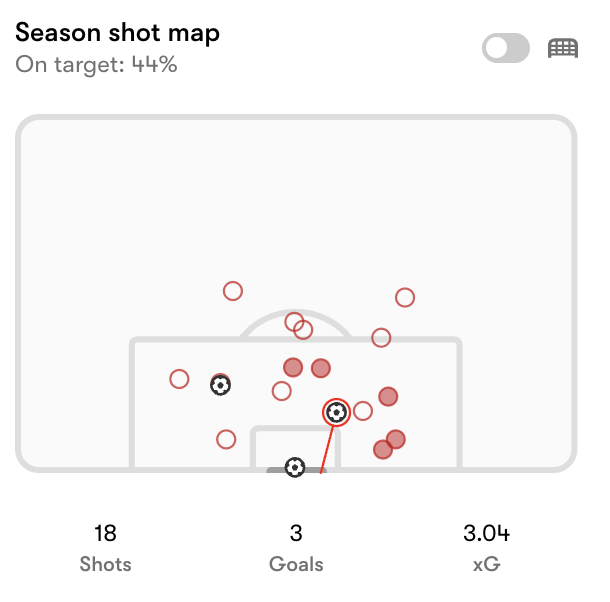
Here's David's shotmap from this World Cup - a reminder that all three goals, and a good chunk of the shots in the box, all came from that Qatar game (FotMob)
Of course, to say that ignores context, given that he scored all three goals in that same game.
When you remove that Qatar game from David’s stats, however, things look a lot worse, as he only had 1.06 xG in Canada’s other four games, coming from just 10 shot attempts.
For a striker of his quality, that’s less than ideal, as most of the other top forwards at this World Cup are averaging upwards of three to four shots per game, such as Mbappé (who has 5.2 shots per 90), Haaland (3.9 shots per 90) and Kane (3.5 shots per 90), showing how much David’s lack of volume stands out relative to his peers.
Yet, that ties into the reality that Canada dealt with in this tournament - their system didn’t seem to get the most out of David, who struggled to generate high-quality attempts (it also stands out that his xG per shot was barely over 0.10 outside of the Qatar game, when he typically averaged closer to 0.20 at Lille).
Jonathan David with the first major chance of the match! #FIFAWorldCup pic.twitter.com/yXL6Qp0Nyr
— TSN (@TSN_Sports) July 4, 2026
For example, it stands out in a big way that of the 12 big chances Canada missed, David was only responsible for one of them - Cyle Larin, Tani Oluwaseyi, Tajon Buchanan and Derek Cornelius all missed two apiece, while Alistair Johnston, Moïse Bombito and Richie Laryea all missed one.
WHAT A STOP FROM BOUNOU! #FIFAWorldCup pic.twitter.com/hqP8Qqe0GO
— TSN (@TSN_Sports) July 4, 2026
Could David have scored this chance if it had fallen to him?
What that shows, though, is that Canada’s finishing woes cannot just be solved by plugging in new individuals, given that they haven’t even gotten the most out of who they have at their disposal. Had David missed a bunch of chances, you could suggest that Canada would need to replace him with someone who could score, but he had only three big chances all tournament and scored two of them. That’s not bad at all, and shows that Canada didn’t do enough to supply him with chances.
The main reason for his lack of involvement around goal, however, is his deployment as more of a #10 in Jesse Marsch’s system, who has asked David to play off another striker, such as Cyle Larin or Tani Oluwaseyi (Larin had two starts this tournament, and Oluwaseyi three).
Tani Oluwaseyi and Jonathan David get a HUGE chance but South Africa keeps it out.#FIFAWorldCup pic.twitter.com/llnOCGoXWe
— TSN (@TSN_Sports) June 28, 2026
Despite being asked to play as more of a creator, however, David struggled to do that, as he created just three chances across five games, which was tied for seventh among Canadian attackers. 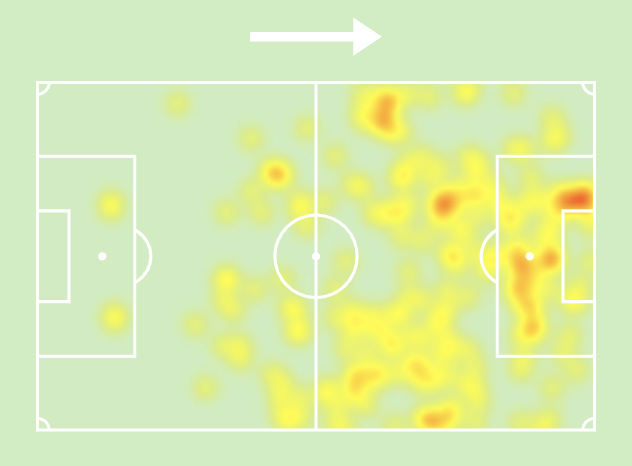
Here's David's heatmap from this tournament, which shows that most of his involvement came all over the final third, and not in the box as one would hope to see (SofaScore)
That’s less than ideal, as it shows that not only did David’s goalscoring abilities get sacrificed with him playing deeper on the pitch, but that Canada didn’t even benefit from the trade-off of him playing more of a creative role.
You can see the impact that had on Canada’s attack when looking at Canada’s field tilt map courtesy of Futi. As seen on the chart below, Canada struggled to see much of the ball in central areas, as most of their attacks were concentrated down the flanks, instead of the two most dangerous areas of the pitch. 
Here's Futi's field tilt map for Canada, which shows their struggles at finding possession in and around the penalty area and the edge of the box (Futi)
Yet, that’s another thing that stood out from Canada’s attack - they struggled with their crossing this tournament. Per WyScout, they attempted an average of 23.6 crosses per game, connecting with 37.3% of them, which isn’t bad, but according to their data, Canada only generated three shots all tournament directly off crosses. Considering how much crossing volume they had, that’s an extremely surprising number. 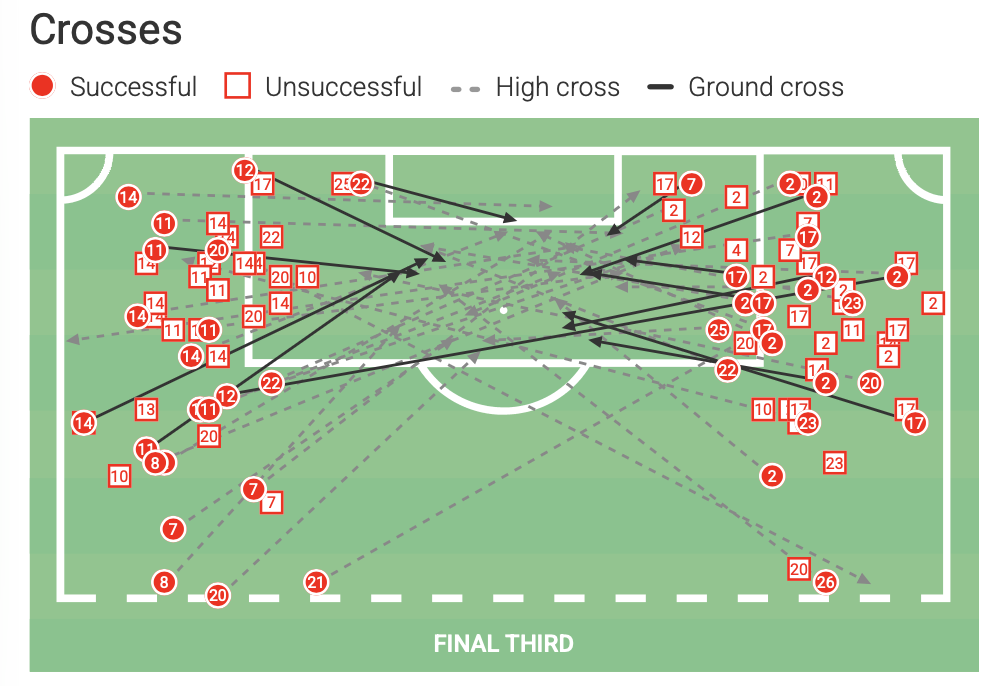
Here's Canada's crossing map from this tournament, showing the issues they had there. It stands out that they didn't have a particular crossing strategy, with there being a wide combination of deeper crosses, cutbacks and flat deliveries (WyScout)
While it’s unclear how WyScout tracks crosses, as Promise David’s goal against Switzerland wasn’t included in that crossing data, that still helps paint a picture of Canada’s struggles in that area.
Often, a lot of Canada’s attacking sequences would end with a winger or a fullback sending in a hopeful cross, one that their teammates would struggle to get on the end of.
That wasn't a new issue, but it was noticeable nonetheless, especially in games where Canada had to face opponents who were sitting back and protecting their box, which was an area where they struggled to break down their opponents. 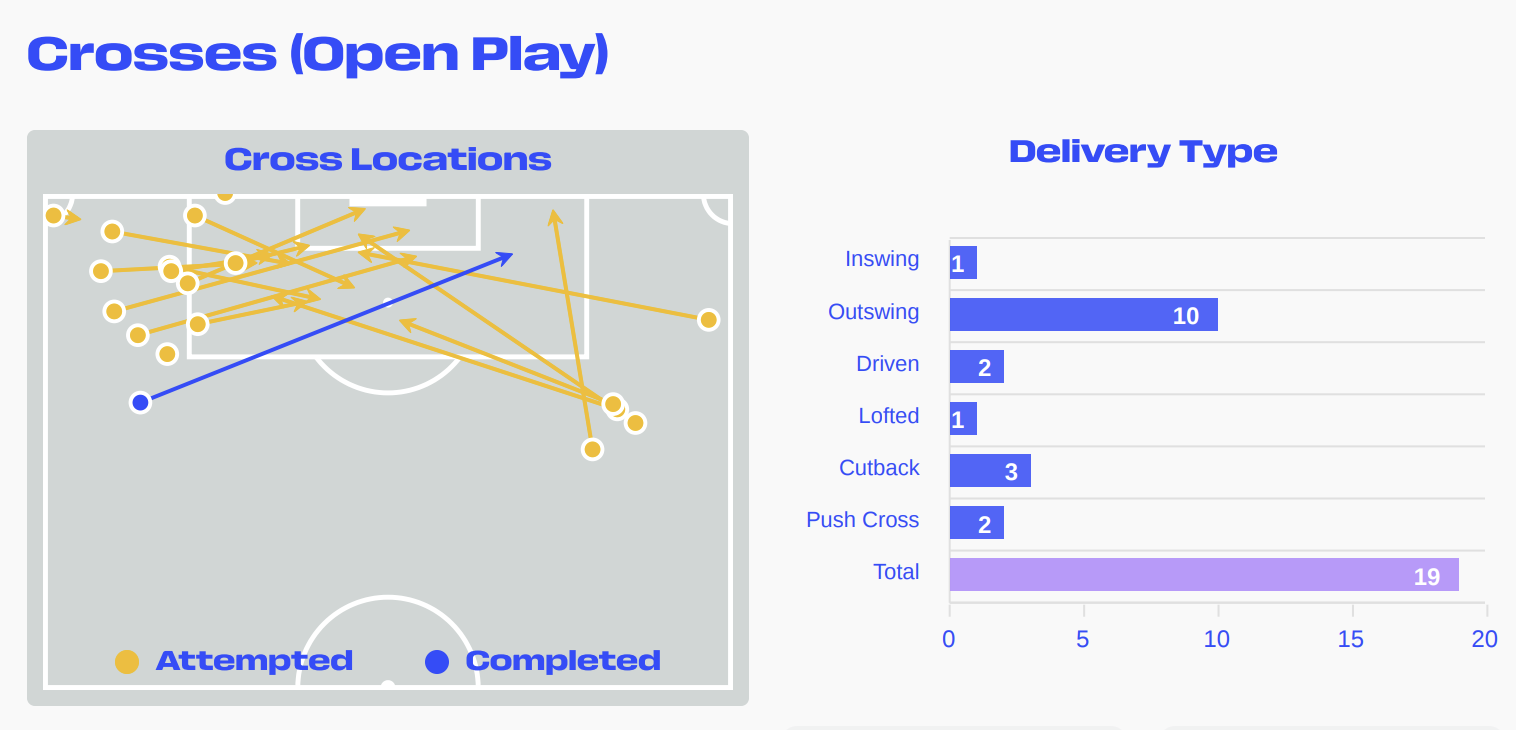
According to FIFA, Canada had just one successful cross out of 19 attempts against Morocco (FIFA)
When looking at that, however, it begs the question: how can Canada fix these problems?
Namely, the big one would be to return David to more of a natural striker position. Since Canada still generated a decent number of chances despite his woes and their crossing issues, it shows that they could still provide him decent service, but he can only take advantage of that if he’s actually deployed higher up the pitch. For example, could Canada be better at crosses if he was playing as more of a striker?
Elsewhere, improving their wide play has to remain a priority. Between wingers Ali Ahmed, Tajon Buchanan and Liam Millar, as well as full backs Alistair Johnston, Richie Laryea and Alphonso Davies (when healthy), they should have the personnel to be more dangerous in their combination play and crossing - especially if Canada can also subsequently improve their attacking movement.
Lastly, one can only wonder if they could benefit from some sort of formation change. For example, could it benefit Canada to play with one striker, that being David, allowing them to deploy another midfielder to help control games and to help Canada progress the ball up the pitch? Or to even play with more of a true #10 with the creativity to supply David and the wingers with service? Or could Canada try a 3-5-2 that allows them to deploy two true strikers and a #10 up front without sacrificing wide play?
At this stage, anything will be on the table for Canada, as a lot of these finishing woes have remained present for most of Marsch’s tenure - they’ve only become a lot more noticeable as of late after David has gone on a slump where he’s been held scoreless in 12 of Canada’s last 14 games, as his performances in 2024 and 2025 masked a lot of these issues.
This team can score goals, but they’ve shown that in bursts, instead of consistently, which is why they’ll have to ponder potential tweaks to solve the woes they experienced at this tournament.
Lastly, though, they’ll also want to experiment with new personnel, too.
One has to imagine that we’re going to now hear a lot of Promise David this cycle after he scored a goal and had an assist in limited minutes this World Cup, as he could be another name that helps Canada’s scoring woes.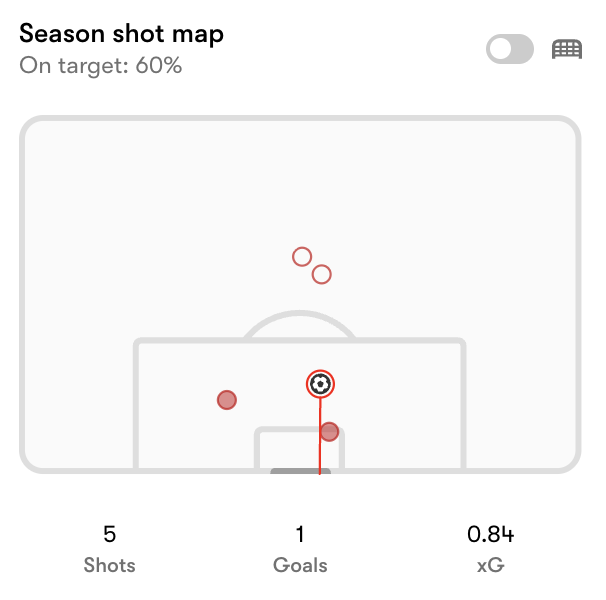
Despite playing fewer than 90 minutes at this World Cup, Promise David was able to generate five shots and score a goal, as seen from his shot map (FotMob)
That he’s already scored four goals for Canada in barely over 300 minutes shows that. With his profile as an out-and-out striker, he could pair nicely with the other David - in their two starts together, Jonathan has three goals and Promise has one goal, showing that there could still be a world where J. David plays as a second striker and still has success. 
And, of course, there are the other forwards who aren’t even on this team, such as Jacen Russell-Rowe, Aribim Pepple, Daniel Jebbison and others, who could come in and give Canada other different profiles to experiment with up front. With Canada’s woes, you have to imagine they give them all an extended look, given that they have plenty of opportunities to do that over the next few years.
Therefore, look for them to immediately begin to address this goalscoring issue going forward, as that could be the difference for them as they look to build on what they learned at this World Cup.
If they can solve these woes in time for the next World Cup, they could be in a very good position to have some success at that tournament, given how young this team still is.
Because of that, look for them to rectify those changes, as it’ll also be key to them accomplishing their short-term goals, which include winning a trophy. Hard to do that if you don’t score goals, after all, so it shows that they won’t want to waste any time in terms of figuring out how to juice their attack going forward.