KEY TAKEAWAYS: The CanWNT's woes against top 10 sides continue in 1-0 loss to Brazil


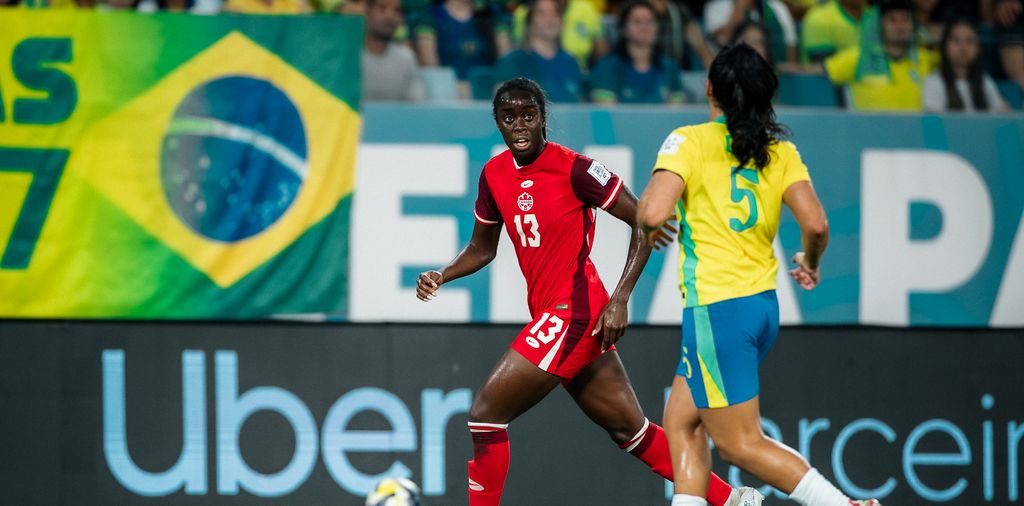
The CanWNT closed out the FIFA Series on a bittersweet note, as they fell 1-0 to Brazil in Cuiabá on Saturday.
After opening the tournament with a pair of wins against Zambia and Korea Republic, Canada was hoping to maintain that momentum heading into their third match, which was against the hosts of these FIFA Series.
A battle between two top 10 sides in the world per the FIFA Rankings, Canada always knew that this was going to be a tough game, and that proved to be accurate as time went on.
FIFA Series 2026 comes to a close, so what comes next for the CanWNT? 🇨🇦 pic.twitter.com/BTUiak2oDq
— OneSoccer (@onesoccer) April 19, 2026
Having done well to control proceedings for most of their first two games, Canada struggled to impose themselves in the same way against a savvy and physical Brazilian side, one that did a good job of playing this game at a high tempo. Considering the humid weather in which this game was played, that approach clearly favoured the hosts, who were slowly able to wear down Canada en route to victory - even despite playing the last stretch of the game while down a player after a red card to Ary Borges.
Therefore, while Canada will have plenty of positives to extract from this game, they’ll be left frustrated with how things turned out for them in the end. While this was another solid performance to continue their good start to 2026, they were also left wanting more, as they were hoping to prove their credentials against a top 10 side with an authoritative victory.
For now, though, they’ll have to wait a few more months to get that win, so look for them to take the positives out of what they learned this tournament, before they get set for their next friendlies in June.
Before looking too far ahead, however, here are three KEY takeaways from this one.
Canada’s woes continue against top opposition:
 It’s been a tough run for Canada against top 10 sides as of late, and that continued in this game, as they suffered their sixth straight defeat against teams that currently sit inside the top 10 of the FIFA Rankings as of writing.
Since their 1-1 draw against current world #1 Spain on October 25th of 2024, Canada has lost all six of the matches they’ve played against top 10 teams, which have come against #2 United States (x2), #5 Japan (x2), #10 Netherlands, and now #6 Brazil.
Not only that but they’ve failed to score in any of those games, either, losing by a cumulative score of 10-0, as they’ve struggled to find the level needed on both sides of the ball in order to secure a victory.
I love Casey Stoney’s bluntness. On the post match zoom call, I pointed out #canWNT had lots its last 6 games vs top 10 nations. I couldn’t even get my question out about what the team needs to do to be more more competitive vs those nations when she simply said, “Goals.”
— John Molinaro (@JohnMolinaro) April 19, 2026
That’s a big worry, because heading into next year, Canada’s going to need to find a way to be better against these sort of teams if they’re to have any aspirations of making a deep run at the World Cup - they’ve only got past the Round of 16 of that tournament just once since reaching the semi-finals in 2003, after all.
Of course, as some will point out, Canada will need to qualify for that tournament first before they start worrying about how they do there, but to say that feels alarmist - Canada should have almost no problems being one of the four teams from Concacaf that qualify automatically for the World Cup, even if they have a disastrous Concacaf Championships (the bigger worry is if they make the Olympics, although that is also easier to do than past years with the expansion of that tournament from 12 to 16 teams, granting Concacaf three berths instead of two).
Plus, it needs to be noted that Canada is still ranked ninth in the world in the FIFA Rankings - because of that, it’s not unfair to look at games like this through the lens of a team that has aspirations to make some noise at next summer’s World Cup.
When doing that, it perhaps makes this performance feel a bit more frustrating than it actually was, because it ties into some of the bigger-picture worries that exist about this Canadian team’s ability to go up against top-10 teams.
In isolation, this wasn’t a bad performance, just as Canada actually did pretty well in their other match against a top-10 team this year, a 1-0 loss to the United States at the SheBelieves Cup. While they didn’t find a victory in either of these matches, they showed off a clear identity and had the right intensity for a match of that calibre.
That’s worth noting because in their previous four losses against top-10 teams, which all came in 2025, Canada looked incoherent tactically and struggled to find the intensity required for those matches. When you consider that, it paints these last two games in a pretty good light.
At the same time, it can be said that Canada still has work to do if they’re to get the level that they’ll need to hit if they’re to compete with these top 10 sides. For example, it absolutely stands out from this game that Canada were outshot 23-10 by Brazil, who generated 2.11 xG to Canada’s 0.87 on the day.
In the end, Brazil were deserving of their victory, as they kept Canada’s attack quiet, controlled the tempo of the game and were clinical when called upon, which is exactly what top teams do.
Canada is still figuring out how to do that consistently - that’s only natural for a team entering just its second year under head coach Casey Stoney - as has even been sometimes seen when Canada plays teams they’re expected to dominate. For as good as they were in a 4-0 win against Zambia this tournament, just to name an example, there were moments where they didn’t push the tempo as high as they could’ve in that decisive victory (Brazil beat that same Zambia side 6-1, for context).
Therefore, the big goal for Canada will be to figure out how to impose themselves on matches, the way they’ve slowly been able to do more and more against lower-ranked opponents lately.
As seen with this loss, and that recent defeat to the US, this Canadian team remains more than capable of holding their own in games like this, but the difference between top teams and elite ones is that the latter typically play games on their terms, and Canada is still finding the best way to do that in these sorts of matches.
The pros and cons of Canada’s direct approach on full display:
Interestingly, after starting this tournament with a strong emphasis on short build-up play, Canada switched it up in a big way in this game.
Granted, that wasn’t that surprising to see - they were lucky not to get punished for some of the dangerous short passes they played in their win against South Korea, something that a team like Brazil likely wouldn’t have let them get away with.
Because of that, Canada came into this game with a desire to play more directly, as they immediately started to go long on most of their restarts and when building out of the back right from the first minute. In particular, it was clear to see that goalkeeper Kailen Sheridan had a memo to not play around with the ball too much - 29 of her 33 attempted passes were classified as long balls, per SofaScore. 
Here's Sheridan's pass map from this game - as seen here, she sent most of her attempts long, and directly up the pitch (SofaScore)
That was interesting to see, as it put a lot of pressure on Canada’s striker, Evelyne Viens, to try and make some of these longer passes stick, as well as on Canada’s midfielders, who had to be alert and ready to try and win some of the second balls that were up for grabs. 
Here's an example where a long ball helped Canada create a dangerous attack, as Simi Awujo did well to flick a ball that Evelyne Viens then progressed to Cloé Lacasse (OneSoccer/TSN)
To Canada’s credit, the decision to play more directly did pay off on several occasions, especially early. Thanks to Viens’s desire to push high up the field and Sheridan’s ability to kick the ball long, they had a few great sequences that started with simple long balls.
Here's one of Canada's best chances of the game, which came from a sequence where Canada went long and won a few crucial second balls, allowing them to generate a good transition moment (OneSoccer/TSN)
It wasn’t an easy day for Viens, who only had 26 touches, five out of 13 completed passes and had to contest 14 duels (winning eight of them), but the Canadian striker did well to be effective despite that - and she was unlucky not to score after she had a header hit the post on a set-piece, too. 
Here's Viens' pass map from this game - as seen here, she didn't get a whole lot of service up front, at least in terms of playing with the ball at her feet (SofaScore)
At the same time, for all of the good moments Canada had with the long ball, they also had some struggles, especially in the stretches of the game where they were unable to find Viens (who also played a large portion of this game with Brazil’s Isa Haas all over her back).
Specifically, it appeared that Canada wasn’t always set up in the most optimal situation to take advantage of second balls and flicked on balls, which led to some missed attacking opportunities and even some dangerous turnovers. 
Here's a moment where Canada didn't offer the support to Evelyne Viens, who actually did pretty well to make the ball stick, leading to a dangerous Brazilian counter-attack (OneSoccer/TSN)
Having started the game in the 4-2-3-1 they’ve often preferred to use as of late, the wingers were instructed to play quite high and narrow alongside Viens, with Simi Awujo supporting underneath as a #10.
In hindsight, though, one can wonder if the wingers might’ve been better off playing a bit wider, as there were a few occasions where Viens flicked the ball behind Brazil’s backline, but Canada’s wingers weren’t set up to get on the end of those balls.
Then, you can also wonder if Canada could’ve benefitted from having another midfielder alongside Awujo with a single six underneath, instead of a double-pivot, as Awujo wasn’t always able to get on the end of the second balls that came from the long passes Canada were sending - something that another higher midfielder could’ve probably helped with. 
Here's Awujo's recoveries from this game - ideally, she would've been set up to have even more with the number of second balls that were up for grabs (SofaScore)
Of course, it’s worth noting that tweaking the system to deploy the wingers and midfielders more aggressively could’ve cost Canada a bit of solidity defensively, which is a valid concern, although you’d have to think that’d be a trade-off they could’ve lived with if it meant being even more dangerous from those long balls. 
Here's Canada's attack map from this game, showing that they didn't get into the final third as much as hoped (SofaScore)
A benefit of frequently going long is that you don’t need as much support to shut down transition moments, especially if you’re set up to stretch the pitch wide for flick-ons and to constantly win second balls in the midfield. 
Plus, whenever Canada had spells where they struggled to win second balls, that also just allowed Brazil to pick up the pace of the game, something they might’ve struggled to do had Canada been a bit more aggressive in those situations, too.
Yet, that’s the duality of Canada’s long ball strategy - it helped them avoid critical errors and helped them generate a few dangerous chances (although they'll be worreid that they didn't generate a big chance and had an average xG per shot of 0.08), but it also made it harder for them to control the pace of the game.
Here's another example of Canada nearly scoring off a long ball - something they might not have been able to do without dynamic movement up front (OneSoccer/TSN)
Clean sheets continue to be elusive for Canada:
It’ll frustrate Canada that for the 13th time in their last 15 games, they were unable to keep a clean sheet, as Aline Gomes’s wonderful half-volley spoiled Canada’s defensive effort on the day.
While Brazil was quite deserving of that goal based on the statistics, it’s worth noting that Canada actually defended quite solidly across the game - 12 of Brazil’s 23 shots came outside of the box, and they generated just two big chances. 
Here's Brazil's shot map from this game - as seen here, a lot of their attempts came from outside of the box (SofaScore)
As a result, in terms of shot quality, Brazil’s xG per shot was just 0.09, which is not bad at all from a Canadian perspective.
Therefore, Canada can be quite pleased with how they overall protected their box in this game, as they did a good job of defending 1v1 in wide areas, clearing crosses and forcing Brazil to shoot from distance.
At the same time, while Canada defended solidly, they’ll be left to nitpick some areas where they could’ve been cleaner, with the big one being how they defended when they pushed high up the pitch. A large reason why Canada was mostly pretty solid defensively is because they had a pretty conservative defensive line, as they weren’t always so eager to push their defenders high up the pitch, likely due to the threats posed by Brazil’s attack and perhaps even the heat.
Of course, with how Canada typically wants to play, which is to defend compactly and aggressively with little space between their lines, they had to push up the field on several occasions to ensure they didn’t leave enormous gaps on the field, and there, they surprisingly struggled.
ANALYSIS 🔎
— OneSoccer (@onesoccer) April 19, 2026
Brazil 🇧🇷 put up relentless pressure vs. the CanWNT 🇨🇦, so what did @amy13walsh make of how the Canadian backline held up against it? 👀 pic.twitter.com/fRsfLC1oTB
For example, the goal that Brazil scored all started with a play where Canada wasn’t maybe as quick as they should’ve been to push their line high up the field, which allowed Brazil to play in behind them with a long ball.
GOAL 🇧🇷
— OneSoccer (@onesoccer) April 19, 2026
Aline Gomes gives Brazil a 1-0 lead over the CanWNT 🇨🇦 early in the 2nd half despite calls for a VAR review, which go unanswered
🔴 Watch LIVE on OneSoccer & TSN pic.twitter.com/xjX6FKgnlK
And there were a few occasions throughout the game where Canada got caught out on similar plays, which is where Brazil had their best chances.

Here's another moment where Canada was caught high up the pitch, but they were lucky not to concede here. Something to watch (OneSoccer/TSN)
That’s worth noting, because it’s no secret that this Canadian team wants to be more aggressive defensively, as that won’t just help them become an even better defensive team - it’ll give them a bit more juice offensively if they can become a better high pressing side.
It’s no secret that this Canadian team is quite good at defending their box, but they’ll now need to find a way to combine that elite low block defending with some more aggressive defensive actions, which have become a key characteristic of the modern game.
Although it must be noted that a game like this is where someone like Jade Rose, who was serving a suspension for a red card against South Korea, was sorely missed. With her speed and ability on the ball, she’ll be a big asset for Canada as they look to defend more aggressively going forward, so they can avoid the woes that hurt them in this defeat.